
Rafa Yunta and the case that reopened the Real Madrid-Barcelona feud after the 11-1 Cup win
The 1943 Copa semifinal between Real Madrid and Barcelona produced one of the most lopsided scorelines in Spanish football history and a forced reconciliation that lasted only a few months. The attempted signing of Rafa Yunta by Barcelona in 1945, reported by Santiago Bernabéu with a notary as witness, turned an amateur contract into the new flashpoint between the two clubs.
 Byvarela8 min read
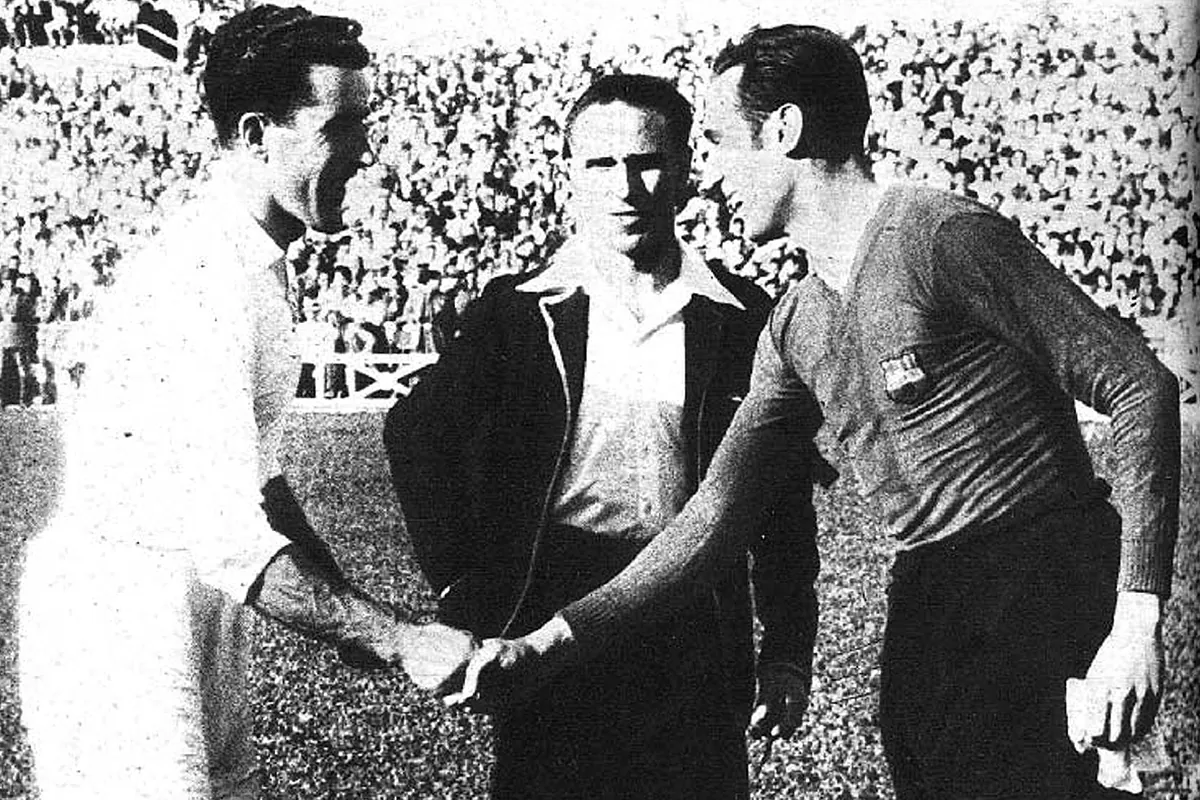
The 11-1 win that sent Real Madrid through to the Copa final at Barcelona's expense in 1943 left more than one of the heaviest scorelines in the rivalry's history. It also set in motion a regime-backed reconciliation that collapsed within months. Barcelona's attempt to sign Rafa Yunta, an amateur forward from Toledo who was playing for Madrid, ended in a federation complaint and a ban that reignited the feud in 1945.
- Real Madrid overturned a 3-0 first-leg deficit with an 11-1 victory at Chamartín amid a hostile atmosphere and a disputed sending-off.
- Both clubs later staged the so-called Copa de la Concordia with two friendlies and a packed programme of official courtesies.
- Santiago Bernabéu set a trap to expose the contact between Rafa Yunta and Barcelona secretary Joaquín Labuena.
- The federation suspended Labuena for two years and blocked Rafa Yunta from joining Barcelona for the same period.
- The case ended the fragile peace: Madrid saw a broken agreement, Barcelona saw a carefully laid ambush.
How the 11-1 unfolded at the old Chamartín ground
Barcelona won the first leg 3-0 on 6 June 1943. The match report sent to the Madrid daily YA by its sports editor, Eduardo Teus, put the loss down to a ferocious atmosphere that he claimed had dragged referee Fombona into decisive mistakes. That account took hold in the capital and turned the return leg into a matter of wounded pride.
The build-up to the game on 13 June was highly charged. A tin whistle manufacturer increased production to sell them near the busy ticket offices on Calle de la Victoria, and the crowd arrived at the stadium convinced that the perceived insult had to be answered. The match was played at the old Chamartín ground, located almost where the Bernabéu now stands, although aligned parallel to Padre Damián rather than La Castellana.
Real Madrid came out flying. Pruden made it 1-0 after six minutes and Barinaga added a second in the 28th. Soon after came the dismissal of Benito for a challenge on Alsúa. Referee Celestino Rodríguez blew for the foul just as Barinaga was scoring what would have been a third, a goal he did not award, and amid the uproar he reached for the red card. Barcelona's camp regarded the sending-off as disproportionate.
Down to ten men and with the noise of the whistles filling the ground, Barcelona conceded six more goals in sixteen minutes. The half ended 8-0 and, according to the account that has survived, coach Nogués decided his team would not return for the second half. A police officer came into the visiting dressing room and ordered the players back onto the pitch under threat of being taken to the cells. The second period brought three more Madrid goals and a solitary Barcelona strike greeted with jeers.
The regime's response and the appointment of new presidents
The episode became a problem for the regime, which was wary of football feeding grievances that could spill into territorial tensions. The federation fined both clubs. Barcelona president Enrique Piñeyro, the Marqués de la Mesa de Asta, resigned, and Real Madrid president Santos Peralba followed him out of office.
At Barcelona, government involvement brought in Josep Antoni de Albert Muntadas, a textile industrialist who left after 35 days to become vice-president of the Catalan Football Federation. He was replaced by José Vendrell, a reserve colonel. At Real Madrid, the chosen man was Santiago Bernabéu, a former player and club secretary who had fought on the Francoist side during the Civil War.
The Copa de la Concordia, a peace staged by Real Madrid and Barcelona
Shortly after taking over, Bernabéu proposed a double friendly to heal the rift. The first match was played on 31 October 1943 in Madrid as a tribute to Monjardín, an old teammate of Bernabéu's from their playing days. The protocol was carefully managed: the city council received the Barcelona party, the squad visited the Alcázar of Toledo, attended the racecourse as Madrid's guests, and each visiting player was presented with a gold lighter while the club received a silver amphora.
The match ended 1-1. Barcelona returned the courtesies on 26 December, St Stephen's Day, with a reception that included mass at La Mercè, a tour of the Poble Espanyol on Montjuïc and a joint training session captured by photographers. Before the match, staged as a tribute to the retired Antonio Franco, Colonel Vendrell came down to the pitch to greet the Real Madrid players individually and hand each of them a watch.
Barcelona won 4-0 and claimed the Copa de la Concordia, a trophy created for the occasion. On the surface, six months after the 11-1, relations between the two clubs had returned to normal. But the truce proved fragile.
Rafa Yunta, the signing that blew it up: Bernabéu's notary trap
In the summer of 1944, Real Madrid brought in Rafael Yunta Navarro, an inside forward from Ocaña, Toledo, who had impressed at Ferroviaria and Toledo. He arrived as an amateur on a very modest compensation package and became a regular starter. Towards the end of the season he began pressing for better terms. The club stalled, and the player grew restless.
Amateur players were not bound by the retention right that constrained professionals, who could be kept by their clubs at the end of a contract simply by offering a 10% pay rise. That made it easier for Barcelona to approach Yunta through their secretary Joaquín Labuena. The player told Bernabéu in the hope of strengthening his hand, and the president's response changed everything.
Bernabéu asked Yunta to play along and arrange a meeting with Labuena on 22 June at the Dollar café, in the La Unión y el Fénix building where Alcalá and Gran Vía meet. The president chose the table and seated four friends at the next one, including a notary who recorded the offer. Armed with that document, Madrid filed a complaint with the federation under the peace agreements that barred clubs from approaching players without the rival board's knowledge.
The ruling came on 29 November 1945. The federation suspended Joaquín Labuena for two years without even calling him to testify, fined Rafa Yunta and banned him from joining Barcelona for the same period. With that decision, the reconciliation was buried for good.
What happened to Rafa Yunta after the case that divided Madrid and Barcelona
Yunta's career shifted sharply. From 23 league appearances in 1944-45, he dropped to two, ten and six over the following seasons. At 28 he moved to Real Valladolid in the top flight, where he performed well and began his coaching career. He later spent more than two decades managing Second Division sides and led Pontevedra to their first ever promotion to the top tier in 1962-63.
His coaching career included lengthy spells at Calvo Sotelo de Puertollano and Cultural Leonesa. He died in León at the age of 91. His name has faded with time, but the case generated plenty of ink in its day and made one thing clear: between Real Madrid and Barcelona, the peace lasted about as long as the ceremony that announced it.
Frequently asked questions
Why did Real Madrid and Barcelona play the Copa de la Concordia?
The Copa de la Concordia was a two-legged friendly arranged in 1943 to ease tensions after the 11-1 Copa semifinal and its aftermath. The first match ended 1-1 in Madrid and Barcelona won the return meeting 4-0.
What did Rafa Yunta do to reignite the conflict between Madrid and Barcelona?
Rafa Yunta, an amateur Real Madrid player, negotiated a move to Barcelona and told Santiago Bernabéu in an effort to force a better contract. Bernabéu arranged a meeting with the Barcelona secretary and placed a notary nearby to record the offer, which led to a federation complaint.
What sanction did the federation impose over the Rafa Yunta case?
The federation suspended Barcelona secretary Joaquín Labuena for two years without calling him to testify. Rafa Yunta was also fined and banned from signing for Barcelona for the same two-year period.