
The defining moments of Messi's Argentina career: a beautiful but difficult journey
Lionel Messi has closed a 21-year international career with Argentina marked by painful defeats, unexpected comebacks and ultimate redemption in the 2022 World Cup. His legacy spans historic scoring records, three major continental trophies and an emotional bond with a country that went from questioning him to treating him as a national treasure.
 ByJavi
 8 min read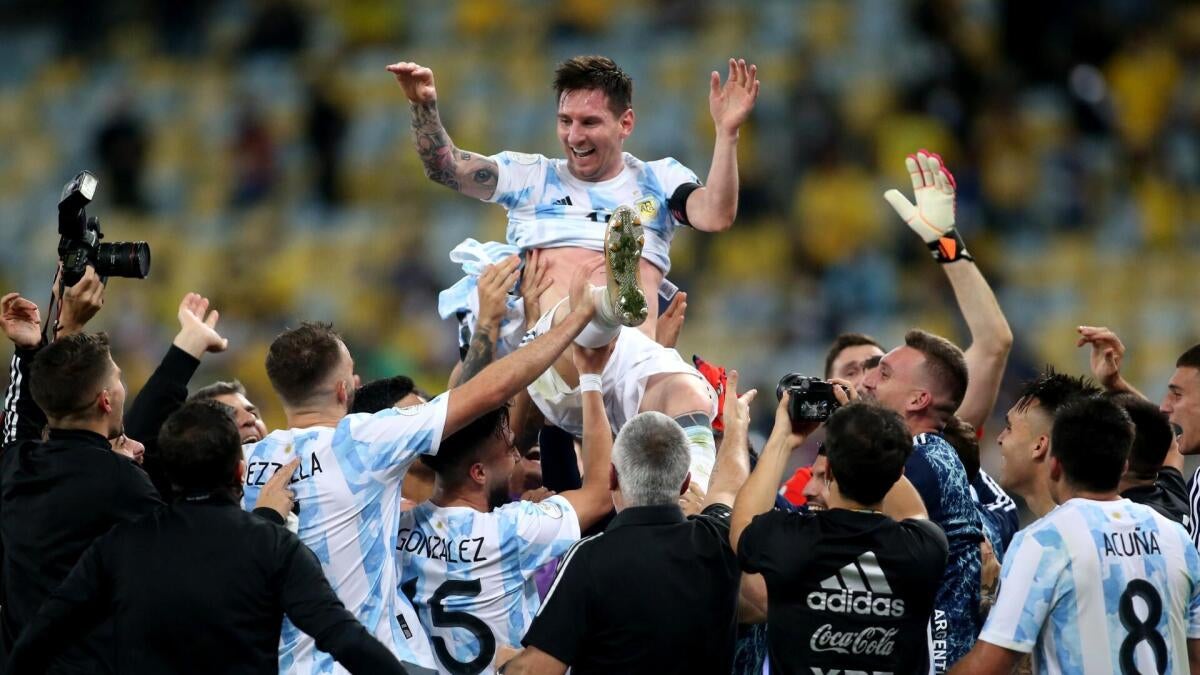
Lionel Messi has ended a 21-year international career with Argentina, a run headlined by the 2022 World Cup title and two Copa America crowns but also filled with brutal defeats, fierce criticism and a brief retirement that changed the course of his relationship with the entire country. The farewell arrived after one last World Cup in which Argentina reached the final without a vintage performance from their captain, but with a send-off worthy of the most important player in the team's history.
- Messi was sent off 90 seconds into his debut against Hungary in 2005, an early sign of the rocky road ahead.
- Before the 2021 Copa America title he had lost four finals, including the 2014 World Cup and the 2015 and 2016 Copa America editions.
- In 2016 he briefly quit international football after losing to Chile on penalties, only to return a few weeks later.
- His hat trick against Ecuador in the final 2018 qualifier kept Argentina alive and preserved their World Cup streak.
- The triumph in Qatar 2022 completed the ultimate redemption arc: from questioned star to beloved national icon.
A debut red card and the promise of a generational talent
Messi's first official appearance for Argentina ended almost as soon as it began. In a 2005 friendly against Hungary, he came on and was shown a red card within 90 seconds for an elbow on an opponent, a decision replays showed to be extremely harsh. The episode did nothing to slow his rise. Weeks earlier he had led Argentina to the title at the FIFA World Youth Championship, and his reputation as a devastating attacking talent was already spreading across the continent.
He made the squad for the 2006 World Cup in Germany and scored his only goal of the tournament in a 6-0 group stage win over Serbia and Montenegro. Argentina went out in the quarterfinals, but Messi kept climbing. He won the gold medal with the under-23 side at the 2008 Beijing Olympics, another clear signal that his international story was only just beginning.
From number 19 to number 10: carrying the Maradona pressure
Messi spent several years wearing the number 19 shirt before inheriting the number 10 after Juan Roman Riquelme's retirement ahead of the 2010 World Cup. The move confirmed his status as the central figure of the Argentina project, although the team again bowed out in the quarterfinals. He failed to score a single goal in South Africa while producing trophy after trophy with Pep Guardiola's Barcelona, a painful contrast for fans who expected the same dominance with the national team.
Diego Maradona was Argentina's coach at that tournament, a presence that only intensified the permanent comparisons between the hero of 1986 and the new leader who could not quite deliver. The 2011 Copa America followed the same script: no goals for Messi and another quarterfinal exit. He was collecting titles with Barcelona at a remarkable rate, but the international stage remained stubbornly elusive.
Three lost finals and the retirement bombshell
The most painful chapter of Messi's international career began at the 2014 World Cup in Brazil. He scored four goals on the way to the final, but Argentina fell to Germany in extra time. It was the first of three straight final defeats, followed by back-to-back Copa America losses to Chile in 2015 and 2016, both on penalties. The best player in the world somehow had no major international trophy to show for all his efforts.
I tried my hardest. It's been four finals, and I was not able to win. I tried everything possible. It hurts me more than anyone, but it is evident that this is not for me.
That 2016 resignation lasted only a few weeks. Messi returned and also reinvented his image: he filled his arms with tattoos and briefly dyed his hair bleach blonde, a striking change that accompanied a period of deep uncertainty for the team. Argentina nearly missed out on qualifying for the 2018 World Cup in Russia, and that was when Messi produced one of his most heroic performances for the national team.
The Quito hat trick and the heavy burden of Russia 2018
Argentina arrived at the final round of South American qualifying with more draws than wins and no margin for error. In Quito, Messi scored a hat trick against Ecuador and carried the team into the World Cup with one of the most memorable individual displays of his international career. That October night in 2017 kept alive a streak that has seen Argentina participate in every World Cup since 1974.
The 2018 tournament began with a 3-0 group stage loss to Croatia and a fresh wave of criticism aimed directly at Messi. He scored only one goal in Russia and Argentina exited in the round of 16 against France, the eventual champions. Maradona delivered a brutal assessment of Messi's leadership and pre-match nerves, comments he later walked back but which captured the intensity of the scrutiny surrounding the star.
The 2021 Copa America and the rebirth of La Albiceleste
The generational shift that reshaped Argentina before the 2022 World Cup changed everything. The national team won the Copa America in 2021, their first major title since 1993, and Messi finally lifted a trophy with the senior side. This Argentina team did not depend solely on their captain, a crucial development that turned the squad into the most successful project of the modern era.
The success in Brazil was the perfect launching pad for Qatar. At 35, Messi was past his physical peak, but his ability to decide matches remained untouched. He scored seven goals in the tournament and finally claimed the one prize that had eluded him for so long. In an unforgettable final against France, he played a role in both regulation goals and converted his penalty in the shootout that secured the title.
I knew God wanted me to be world champion, that he was going to give it to me. I really suffered. But today 95 or 100 percent of Argentinians love me, and that's beautiful.
The final World Cup and a goodbye sung at MetLife Stadium
For years Messi was skeptical about reaching the 2026 World Cup, saying in 2023 that the most normal thing was that he would not be there. An injury-hit 2024 season made his participation seem even less likely, but he ultimately returned for a sixth World Cup with the freedom of a player no longer burdened by pressure. This time he was there to enjoy one last ride with the national team.
The tournament showed that he was no longer the omnipresent force of years past, but his production remained remarkable. He opened the World Cup with a hat trick against Algeria and finished with eight goals, the best single-tournament tally of his career. In the semifinal against England he faded for long stretches, only to deliver two late assists that broke open the match and sent the reigning champions back to the final.
Spain neutralized him completely in the title game and Argentina lost the final with their captain well below his best. Still, the lasting image was powerful: Messi standing alone with a silver medal around his neck and tears in his eyes as thousands chanted his name at MetLife Stadium. The imperfect ending on the pitch became a perfect farewell for a career that stretched across every possible emotional extreme.
Frequently asked questions about Messi's Argentina career
Frequently asked questions
How many titles did Messi win with Argentina?
Messi won four official titles with Argentina's senior national team: the 2022 World Cup, the 2021 and 2024 Copa America titles, and the 2022 Finalissima against Italy. He also won the 2005 FIFA World Youth Championship and the gold medal at the 2008 Beijing Olympics with the under-23 side.
Why did Messi retire from Argentina in 2016?
After losing the Copa America Centenario final to Chile on penalties in 2016, Messi announced his retirement from international football following three consecutive final defeats in three years. He returned to the national team weeks later and continued playing through the 2026 World Cup, where he announced his definitive international retirement.
How many World Cup goals did Messi score?
Messi scored 21 World Cup goals across his six appearances in the tournament, placing him among the all-time leading scorers in competition history. In his final World Cup in 2026 he scored eight goals, his best return in a single edition.