
The first Ballon d'Or turns 100: it is kept in Pozuelo de Alarcón
The trophy won by Real Madrid player Félix Quesada in 1926 still belongs to his family. His great-nieces keep it in a display cabinet at their home in Pozuelo de Alarcón, along with the original box and a few dents. It was awarded by popular vote after a match against Sevilla.
 ByJavi
 8 min read
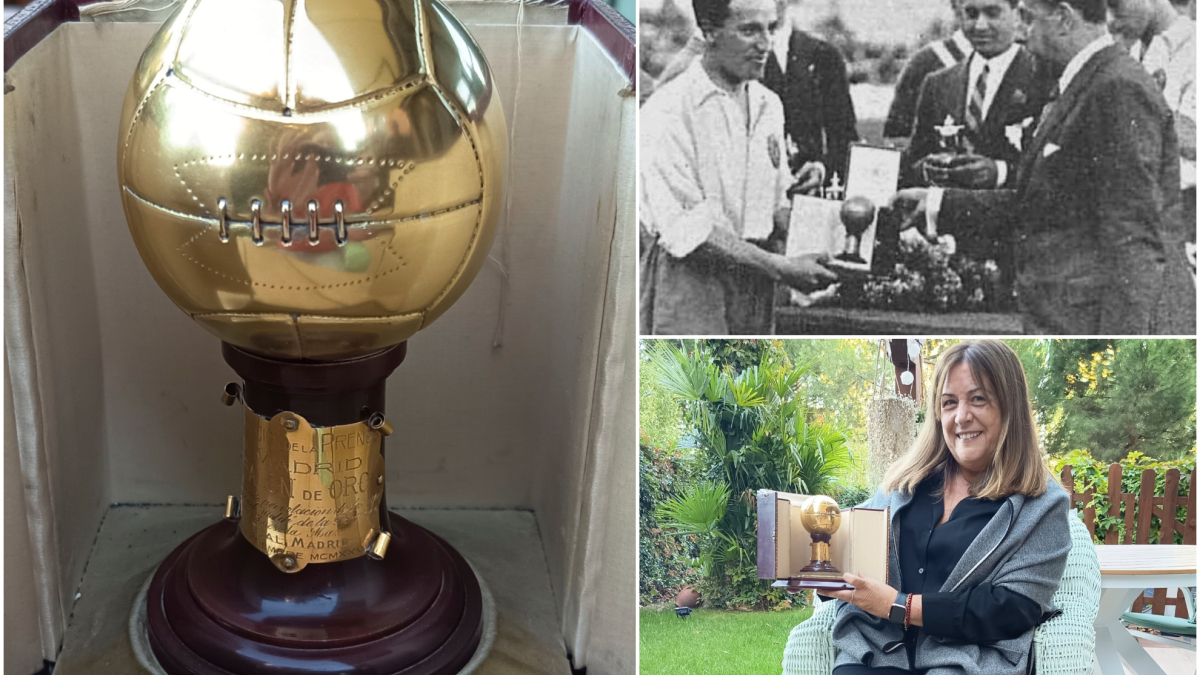
The Ballon d'Or handed out by France Football every year was not the first trophy to carry that name. A century earlier, in 1926, Real Madrid defender Félix Quesada received an award with the same denomination, chosen by popular vote as the best player in a single match against Sevilla. That centenary trophy has not been lost: it remains with his family, specifically in a house in Pozuelo de Alarcón.
- The first Ballon d'Or was awarded in 1926, three decades before the award recognised today worldwide.
- It was won by Félix Quesada, a Real Madrid defender, after a popular vote in a match against Sevilla.
- The trophy is kept by his great-nieces in a house in Pozuelo de Alarcón.
- Quesada played 249 matches for Real Madrid and won 18 titles, including two league championships and two cups.
- The award was created as a football adaptation of the Golden Ear given to bullfighters.
Where the first 1926 Ballon d'Or is kept
Félix Quesada's great-nieces, Quesada Horta and Quesada Martínez, keep the award at the home of Elena, one of them, in Pozuelo de Alarcón. The piece is displayed in a cabinet full of family memories and Real Madrid items, alongside the original box in which it was presented. Time has left a small dent or two on the metal, and family legend has it that during its long life it was even used as a throwing object in more than one argument.
Elena never met Félix in person; he died of illness on 9 July 1959. Her connection to the trophy came through her father, who looked after the footballer's widow in her final years. She remembers visiting the old house on Fernando VI street in Madrid as a child, a home filled with white sheets covering enormous furniture and corridors so long that soup would go cold between the kitchen and the living room. When the widow died, the belongings were shared among the relatives and her father took the Ballon d'Or, which Elena has guarded ever since.
Félix Quesada, a legendary Real Madrid defender
Born on 1 July 1902 at number 4 Fúcar street in central Madrid, Félix Quesada Mas developed as a footballer at the historic Recreativo Español before joining Real Madrid. His arrival at Chamartín was theoretically intended for the youth ranks, but his authority on the pitch quickly earned him a place in the first team. In white he played 249 matches over 14 seasons and lifted 18 titles, a figure that includes two league championships and two cups.
Seen as combative by his own fans and tough by opponents, Quesada was one of the first defenders to specialise in taking penalties. That skill produced most of the 32 goals he scored as a Madrid player. He earned nine caps for Spain and took part in the 4-3 win over England at the Metropolitano stadium in May 1929, the first historic victory against the English side away from the British Isles.
From the bullfighting Golden Ear to the football Ballon d'Or
The award Quesada received was an adaptation to football of the Golden Ear that bullfighters received in that Spain of bullfighting tradition. The Madrid Press Association, which that same year had honoured the Basque matador Martín Agüero for his performance at Vista Alegre, decided to create an equivalent recognition for the best player of the Real Madrid-Sevilla match played on 23 September 1926.
The match had no official status. In fact, a second game between the two teams was played two days later, a common practice when journeys were long and expensive. Each ticket for the match included a voting slip, but the process was not as simple as it might seem today: votes had to be deposited in person at the Association's headquarters on Carretas 10 street in Madrid before 2 October. The ballot boxes were later moved to a notary's office on Barquillo 21 for the official count.
The controversial vote that made Quesada a winner
The winner's name was published in the newspapers on 5 October. Félix Quesada won in a landslide with 1,154 votes, far ahead of the 177 collected by Manuel Roldán, a Sevilla forward, in second place. The logic of the result sparked debate: since the match had been played in Madrid, local players enjoyed the advantage of a potential electorate made up mostly of the capital's residents. The huge gap between first and second fuelled the controversy.
The trophy was presented on 10 October, taking advantage of a Real Madrid-Unión Sporting match in the Central championship that the home side won 3-2. Journalist Rafael Marquina of El Heraldo was in charge of handing the award, made by Talleres Ibarra, to Quesada, in recognition of the role the press played in its creation. A photograph immortalised that moment.
What happened to Quesada after the Ballon d'Or
The Madrid-born defender remained a regular for Real Madrid during the following decade, until the Spanish Civil War briefly removed him from football in September 1936. During that period he worked as a court procurator, although he eventually returned to his passion: first as a coach and later as national team manager.
In the Spain dugout he formed a triumvirate with Paulino Alcántara and Luis Iceta after the 1950 World Cup in Brazil. His brief spell in charge of the national team produced a win over Switzerland and two away draws against Belgium and Sweden. Quesada died a few years later, at 57, just as the France Football Ballon d'Or was taking shape. In 1956 it was won by Stanley Matthews and a new era began. But the first one, a century ago, had borne the name of Félix Quesada.
"My father knew what it was and how important it was. That is why we have kept it, even though we are not big football fans at home. The interest it generates surprises me," says Elena.
The widow who lived for Real Madrid
María Rodríguez Agudo, known as "aunt Maruja", was much more than Félix Quesada's wife. Daughter of a Madrid city councillor and sister of one of the most active Real Madrid members of that era, she herself became the club's number 1 female affiliate, at a time when male and female membership numbers were managed separately. Elena remembers her as a woman who always introduced herself as "Félix Quesada's wife" and who lived obsessed with the white club. "She lived for Real Madrid. She talked about it all day and followed everything, practically obsessed. I think the club did not treat her very well when she died, but to be honest I do not know exactly what happened," her great-niece adds.
Félix and María had no children. When she died, the Real Madrid objects she had kept were shared among the family. Many things were lost over time and during house moves, but photographs, press clippings from the era and, above all, the Ballon d'Or survived. That legacy has also helped Elena reconnect with part of the family after many years.
The pending tribute to a Spanish football pioneer
Félix Quesada's family keeps the memory of the first Ballon d'Or in history alive. Elena, the great-niece who looks after the trophy in Pozuelo de Alarcón, hopes that spreading this story will help pay tribute to a footballer who defined an era at Real Madrid and in the Spanish national team. One hundred years after that match against Sevilla, the recognition of the first winner of an award with this name remains largely pending. "I hope all this serves to honour him," she concludes.
Frequently asked questions
Who won the first Ballon d'Or in history?
The first Ballon d'Or was won by Félix Quesada, a Real Madrid defender, in 1926. He was chosen by popular vote as the best player in a match against Sevilla. The trophy was awarded three decades before the first France Football Ballon d'Or.
Where is the first Ballon d'Or kept today?
The trophy is kept by Félix Quesada's great-nieces in a house in Pozuelo de Alarcón, in the Community of Madrid. It is displayed in a cabinet with the original box and other Real Madrid memorabilia.
How many matches did Félix Quesada play for Real Madrid?
Félix Quesada played 249 official matches for Real Madrid over 14 seasons. He won 18 titles, including two league championships and two cups.