
The referee who sent off Beckham at France 98 breaks his silence 27 years on
Kim Milton Nielsen looks back on the night he showed David Beckham a red card in Argentina's World Cup clash with England in 1998. The Dane reveals the doubts that crossed his mind on the pitch and the lesson he learned while refereeing Barcelona at the Camp Nou. A decision that defined his career and still follows him today.
 ByInfoBlaugrana
 5 min read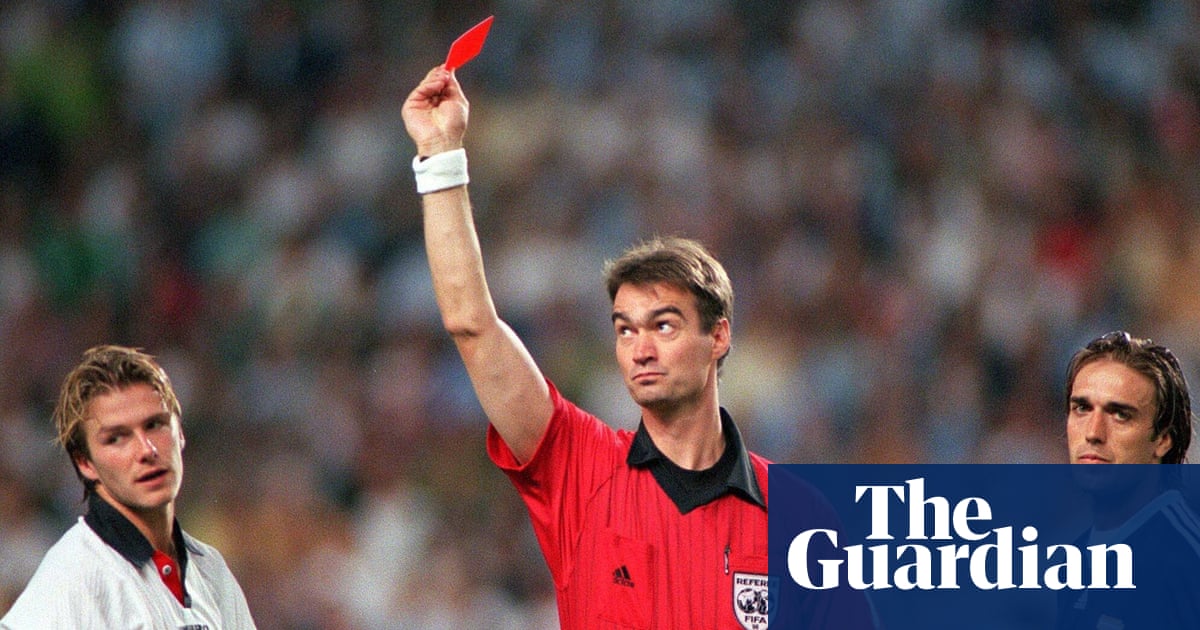
On 30 June 1998, at the Stade Geoffroy-Guichard in Saint-Étienne, Danish referee Kim Milton Nielsen enjoyed the finest first half of his career and, without knowing it, was walking straight into the decision that would define him forever. In the World Cup round of 16, Argentina and England delivered an electric contest. Michael Owen tormented Argentina with blistering runs and a breakout goal, a clever set piece outsmarted the English defence, and Nielsen had already pointed to the penalty spot twice. A memorable second half seemed guaranteed. It was, though not for the reasons the official could have predicted.
- Nielsen, at 37, was refereeing his first major international tournament and had been given a match loaded with historical tension.
- The rivalry between Argentina and England carried the weight of the 1982 Falklands war and controversial World Cup precedents.
- Diego Simeone clattered into David Beckham, tugged his hair after the foul, and the Englishman's flick of the boot earned him a red card.
- An inner voice urged leniency, but Nielsen remembered a lesson from the Camp Nou in 1991: the same rules apply to everyone.
- The Dane admits that changing his mind out of fear of the headlines would have destroyed him as a referee.
The historical tension behind Argentina vs England at France 98
At 37, Nielsen was making his debut at a major international tournament and had been trusted with one of the most symbolically charged fixtures of the competition. The wound of the 1982 Falklands war remained open, and previous World Cup meetings had only deepened the friction: Geoff Hurst's goal in 1966 and Diego Maradona's handball twenty years later were part of an unsettled score that made elimination a colossal failure for whichever side lost.
How David Beckham's red card unfolded
The decisive moment arrived when Simeone crashed into Beckham and the referee blew his whistle, preparing to book the Argentine. Simeone leaned over the Englishman and pulled his hair. Beckham, still on the ground, flicked out his boot; Simeone went down. Nielsen blew again: straight red card for the English superstar, with an entire half still to play.
But the decision was not as simple as it looked from the stands. Sending off a global icon like Beckham at a World Cup, with the match still in the balance, triggered a voice in the Dane's head: was it really a violent act? Had Simeone provoked it? Then he recognised that voice. He had heard it before. And he knew what to do with it.
The Camp Nou lesson that saved his refereeing career
The memory took him back to 1991, to a European Cup tie involving Barcelona at the Camp Nou. A Sparta Prague player was breaking through on goal when Guillermo Amor cynically brought him down. In front of 82,000 Barça fans, Nielsen had to send off one of the home heroes. His instincts urged leniency: a free kick and a yellow card would do. "Barcelona at home against a team from eastern Europe... it would be very easy to close your eyes and not do anything," the referee explained.
If I changed my mind because I was afraid of the headlines, I would have destroyed myself as a referee.
He showed the red card. Sparta Prague scored from the resulting free kick, and Nielsen feared the worst: "I thought: 'Oh my God, I am going to die at the Nou Camp.'" But the press admired the decision. That night he learned that it makes no difference whether it is a big team or a small one, a superstar or a debutant: the rules are the same. Standing in front of Beckham, he repeated that idea to himself.
The price of impartiality after England's exit
England fell in the penalty shootout and, that same night, Nielsen wondered whether he could have done anything more. Then he understood something deeper: giving in to the fear of the headlines would have ended his credibility. "The cost of fairness is high. Sometimes referees must pay," he says. His career backed him up: he became the first official to reach 50 Champions League appearances, in February 2005, and retired in 2006.
A legacy that still follows Nielsen more than two decades later
Kim Milton Nielsen began refereeing in Copenhagen in 1976, and being called up for a World Cup was the pinnacle of that journey. Even so, the world remembers him for a single gesture. "I am surprised, and I have been surprised since, because even small boys who were not born in 1998, they come up to me and they say, 'Hey, you are the man who sent off David Beckham,'" the Dane confesses. The image of Beckham and Simeone remains intact in the collective memory, and so does the man with the whistle who shaped it.
Frequently asked questions
Why was David Beckham sent off at the 1998 World Cup?
Beckham was fouled by Diego Simeone and, after the Argentine tugged his hair, the Englishman flicked out his boot while on the ground. Referee Kim Milton Nielsen judged the reaction to be violent and showed him a straight red card.
What happened after Beckham's red card against Argentina?
England held on with ten men and the match went to a penalty shootout, where Argentina advanced to the quarter-finals. Beckham became the focus of intense criticism in England for months afterwards.
Who refereed Argentina vs England at the 1998 World Cup in France?
The round-of-16 clash was officiated by Denmark's Kim Milton Nielsen, who was 37 at the time and taking charge of his first major international tournament. He had already learned not to be intimidated by the occasion after sending off Guillermo Amor at the Camp Nou.