
Why Mbappé's penalty was not retaken: The encroachment rule that backed the referee in Betis vs Real Madrid
The controversy in Betis vs Real Madrid erupted in the 94th minute after Mbappé missed a penalty and Bartra was accused of encroaching into the box. VAR official Iglesias Villanueva and referee Hernández Hernández decided not to order a retake, and they got it right according to the CTA and IFAB.
 ByNatilla5 min read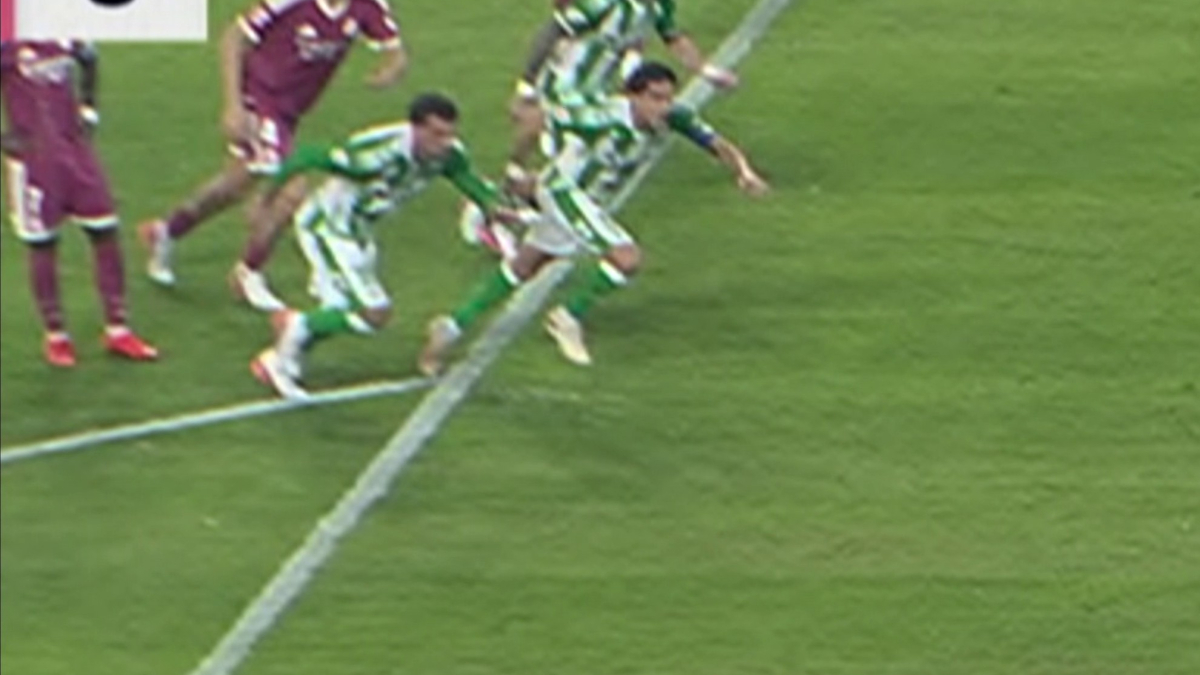
Betis vs Real Madrid produced one of the biggest talking points of the weekend in stoppage time. Kylian Mbappé missed a penalty in the 94th minute and the immediate question was whether Marc Bartra had encroached into the box before the kick. VAR official Iglesias Villanueva and on-field referee Hernández Hernández both agreed that the penalty should not be retaken. The call is fully backed by the Technical Committee of Referees and by the rule IFAB maintains for the 26/27 season.
- VAR reviewed Bartra's possible encroachment on Mbappé's missed penalty and decided not to order a retake.
- Encroachment is only punished if the player who enters the box directly influences the action.
- Encroachment is judged by the position of the feet in contact with the ground, not by the body's projection in the air.
- IFAB keeps this interpretation of the law for the 26/27 season.
What the encroachment rule says about entering the box during a penalty
Encroachment on a penalty kick occurs when a player other than the kicker or the goalkeeper enters the penalty area, the arc or moves in front of the ball before it is struck. But the law includes a crucial detail: not every step forward has to be punished. The referee only intervenes if that player has a real impact on the kick or gets involved in the play that follows.
When a defender and an attacker are punished for encroachment
The punishment depends on who commits the offence. If a defender encroaches, the action is penalised when their presence clearly affects the kicker or when, after a rebound, they play the ball or challenge an opponent and prevent a goal, an attempt on goal or the creation of a clear scoring chance.
If an attacker encroaches, the offence is considered when their position clearly affects the goalkeeper or when, after a rebound, they play or challenge for the ball and score, attempt to score or create a scoring opportunity. In every case, how play is restarted depends on who encroached, the outcome of the kick and how much the early movement influenced what happened afterwards.
How encroachment is judged: feet on the ground and body projection
To determine whether a player has encroached into the area, the position of their feet — or any other part of the body in contact with the ground — is taken into account at the exact moment the ball is struck. Encroachment happens when one or both feet are inside the area or on the line that marks it, including the penalty arc.
What is not considered, however, are the parts of the body in the air or their vertical projection over the pitch. IFAB only takes the body's projection into account when both feet are off the ground.
In the air it only applies when the whole body is off the ground.
The Bartra case in Mbappé's penalty: why it was not retaken
In the Betis vs Real Madrid incident, Bartra had one foot in contact with the ground, so his position had to be assessed from that point of support. From there, the decision not to retake the kick stands because his early movement did not directly influence the penalty or interfere with the subsequent play. That is why VAR and the referee decided a retake was not required.
How IFAB applies the rule in the 26/27 season
The interpretation used in Betis vs Real Madrid is not an isolated novelty. The CTA and IFAB manuals state it clearly for the 26/27 season. The key remains the same: encroachment is only penalised when it genuinely changes the action, and the infringement is measured by contact with the ground, not by the space the body occupies in the air.
Frequently asked questions
Why was the penalty in Betis vs Real Madrid not retaken after Bartra's encroachment?
Because Bartra had one foot in contact with the ground and his early movement did not directly influence Mbappé's kick or the rebound. Under the encroachment rule, simply stepping into the box does not force a retake unless there is a real impact on the play.
What is encroachment on a penalty kick?
Encroachment is the offence committed when a player other than the kicker or the goalkeeper enters the penalty area, the arc or moves in front of the ball before the kick is taken. It is only punished when that player clearly influences the kick or gets involved in the play that follows it.
When is encroachment considered inside the penalty area?
Encroachment is considered when one or both feet of the player are inside the area or on the line that marks it, including the penalty arc, at the exact moment the ball is struck. Body parts in the air and their vertical projection are not taken into account unless both feet are off the ground.